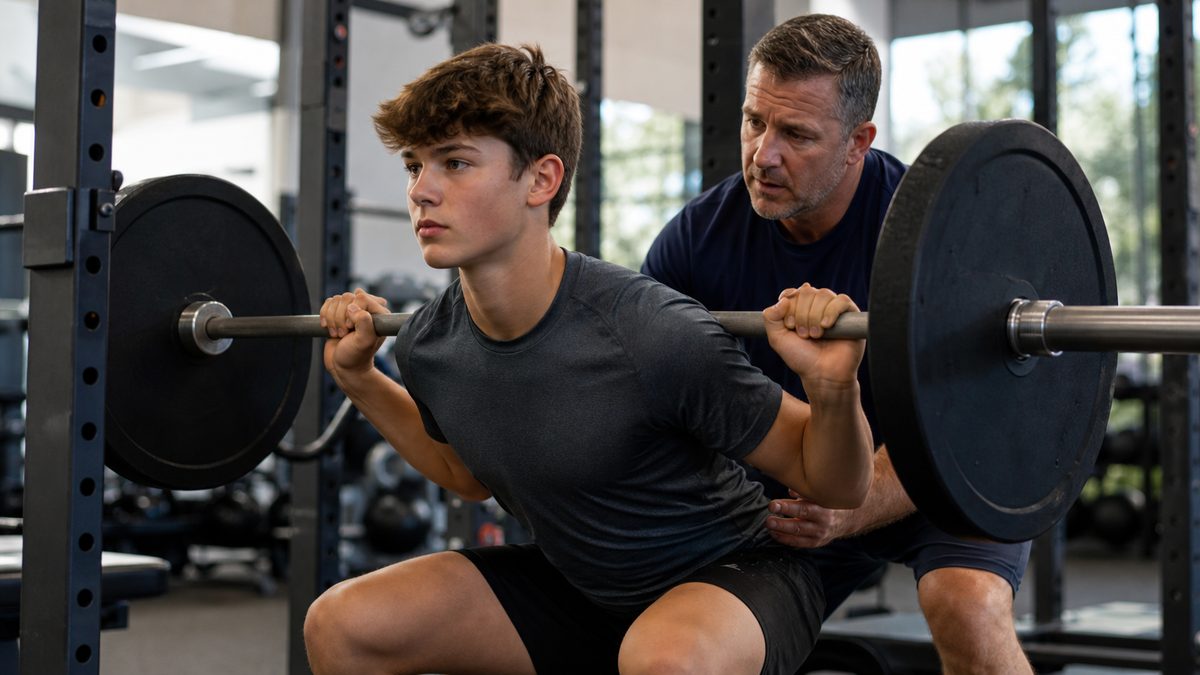
Strength training for teens should be coached as skill development, not a race to lift more weight. A suitable program matches exercises to the teen’s current ability. It uses active supervision, repeatable technique and gradual progression. It also treats sport practices, games, school activity and gym sessions as parts of the same physical workload.
Parents do not need to design workouts or judge every repetition. Their role is to choose a suitable training setting, keep communication open and check that the program responds to the teen in front of the coach. Good training should leave room for honest reports of fatigue, pain, confusion and changing sport demands.
How can you tell whether a teen is ready to begin?
Readiness depends more on behaviour than a fixed starting age. A teen should be able to listen to instructions, stop when asked and practise without turning every task into a contest. They should also be willing to accept corrections and report discomfort honestly.
Strength training does not mean maximal lifting. Resistance can come from human body weight, resistance band, a light external load or adjusted gym equipment. The tool matters less than whether the young person can use it with control.
A teen may be ready for one training setting but not another. Someone who follows instructions well in an individual session may lose focus in a large group. A young athlete who rushes when friends are watching may need closer supervision and simpler tasks.
Before enrolment, parents can check whether the teen:
- wants to take part rather than feeling forced;
- can listen while an exercise is demonstrated;
- stops promptly when the coach gives an instruction;
- can repeat a simple movement without racing;
- accepts an easier version when control is poor;
- speaks honestly about pain, fatigue or uncertainty;
- has access to a coach who can observe the session closely.
A teen who is not ready for a complex program does not need to be excluded from exercise. The coach can reduce distractions, simplify the movement and provide more direct attention. Readiness can change as the teen gains confidence and learns how a coached session works.
What does active supervision look like?
An adult standing in a gym is not the same as active supervision. A coach must select suitable exercises, explain their purpose, demonstrate them and watch the teen perform them. The coach should notice when a set changes from controlled practice into rushed effort.
Good supervision is easy to see. The coach asks about training history and current sport commitments. They place equipment correctly and give short cues the teen can use. They watch working sets instead of turning away. When control fades, they reduce the task, end the set or change the exercise.
Group size matters because a coach cannot correct a repetition they do not see. Impressive equipment does not make up for weak observation. During a trial session, notice how much of the teen’s work the coach watches and whether feedback leads to a visible change.
The coach should also be able to explain why an exercise belongs in the program. The answer does not need technical language. A clear answer might say that the teen is learning to control a squat before adding resistance, or practising a landing position before using a harder jump.
Parents can ask a prospective coach:
- How do you assess a teen before choosing exercises?
- How closely do you watch each working set?
- What makes you stop or change a set?
- How do you record technique and progress?
- How do you adapt sessions during busy sport weeks?
- How can a teen report pain or discomfort during training?
- When and how do you communicate concerns to parents?
A credential can show that a coach completed a course. It cannot show how that person behaves on the gym floor. Judge the coach by the decisions they make, the attention they give and the way they respond when a teen needs a change.
Which movement skills should the program teach?
A useful youth strength program can be understood through movement patterns: squat, hinge, push, pull, brace, carry, jump and land. These are categories, not a rigid checklist for every session. They help a coach choose exercises without building the program around a long collection of machines or isolated movements.
Exercise names matter less than fit. A supported squat may suit a teen who is still learning the position. An unloaded squat may follow once that support is no longer needed. External resistance can come later if the teen keeps the intended range and control.
The same approach applies to a hinge. A coach might first teach the teen to move at the hips while maintaining a steady trunk position. The task can then gain range, resistance or complexity. Adding weight before the pattern is understood only makes the error harder to manage.
Push and pull exercises can be scaled through body position, support, range of motion and resistance. A brace can be taught in a simple position before being used during a carry or another movement. These changes let the coach increase the demand without making load the only goal.
Jumping and landing need coaching too. They should not be scattered through a workout merely to make it feel athletic. The coach should explain the task, watch the landing and stop repetitions when the teen no longer controls the intended position. Attention to balance and recovery supports safe, sustainable progress.
A hypothetical example shows why this framework helps. Imagine two teens doing an exercise with the same name. One moves through a controlled range and responds to a cue. The other rushes, loses position and copies a friend’s load. The exercise may be suitable for the first teen and too demanding for the second. The name of the exercise cannot settle that decision.
Parents do not need to judge fine technical details. Look for steady repetitions, clear coaching and changes that make sense. If a harder variation creates less control, it is not useful progress at that time.
When should resistance or difficulty increase?
Progression should follow repeatable technique. The teen first learns the movement, then performs it consistently. The coach may add manageable practice, improve the usable range or ask for greater control. A modest increase in resistance or a harder variation can follow when those changes do not damage the movement.
Progress can therefore appear in several ways. The teen may need fewer cues. Repetitions may look more alike. They may control a range that was previously difficult or complete suitable work with less rushing. These changes count even when the weight stays the same.
Premature loading looks different. The range becomes shorter, the movement speeds up without intent or the teen changes position to finish the repetition. The coach has to rescue the set repeatedly. Those signs show that the task has moved beyond the standard the program was meant to teach.
Reducing difficulty is a normal program choice. Coordination can feel different during periods of growth. A new exercise may need more practice. Fatigue from sport can also change what the teen can control that day. Using a lighter resistance or simpler variation protects the quality of the session. It is not failure.
A useful training record should include:
- the exercise and variation used;
- the resistance or equipment setting;
- the work completed;
- a brief note about control or coaching cues;
- how difficult the task felt;
- any pain or unusual discomfort reported;
- relevant sport demands around that session.
This record gives the coach more than a list of weights. It shows whether the teen is learning, how the session felt and why the next task should stay the same, move forward or become easier.
How should gym work fit around sport?
Sport and strength work belong on one schedule. A gym session that seems reasonable alone may be poorly placed beside hard practices, games, tournaments, travel and school activity. The coach needs to see the total week rather than treating strength training as a separate workload.
The same session will not suit every week. During a lighter sport period, the teen may have more capacity to learn a new exercise or complete a more demanding session. During a crowded competition period, the coach may reduce difficulty, change exercise selection or focus on familiar skills.
This does not require parents to calculate a perfect workload. It requires shared information. The teen knows how their body feels. The parent may know about travel, sleep disruption and schedule changes. The sport coach knows what happened at practice. The strength coach can use that information to adjust the gym plan.
A weekly calendar should include practices, matches, school sport, strength sessions and unusual events. Share changes as they arise. A replacement match, an extra team session or a demanding school event can alter the week after the original gym plan was written.
Watch for patterns rather than judging one hard day. Unusual fatigue that continues, a persistent drop in performance, pain or growing reluctance to train deserves a review. The response should be a conversation and an appropriate change, not pressure to complete the original plan at all costs.
What should a parent monitor without becoming the coach?
A parent protects the training process. That means choosing an environment where the teen receives attention, supporting reasonable attendance and keeping communication open. It does not mean changing exercises from the side of the gym or pushing for heavier weights.
When can training continue as planned?
The process has a green light when the teen wants to take part, understands the task and can speak openly. The coach knows the current sport schedule, watches the work and changes exercises when needed. Progress remains gradual and technique stays ahead of load.
When should the plan be reviewed?
Review the plan when the teen often appears unusually tired, stops responding to familiar cues or feels pressured to match other athletes. Review it when sport demands rise or the teen starts dreading sessions that they previously accepted. These observations do not provide a diagnosis. They show that the adults need to listen and reconsider the current demand.
When should training stop for further help?
Pain and health concerns should not become tests of toughness. Stop the affected task and seek advice from an appropriate health professional. An article, parent or gym discussion cannot diagnose the cause. A credible coach respects that boundary and does not dismiss symptoms to preserve the workout.
Before the next session, ask one question: can this teen learn under close supervision, progress without pressure and report how they feel honestly? If the answer is no, change the training setting or plan before adding more resistance.