The easiest way to start strength training at home is to clear a safe area and choose one exercise for each main movement pattern. You can begin with bodyweight exercises, a resistance band or one dumbbell. You do not need to copy a commercial gym.
A useful home workout covers a squat or lunge, a hip movement, a push, a pull and controlled trunk work. strength training for beginners. Make it harder by changing one clear variable, such as the exercise version, repetitions, range of motion or resistance.
The room comes first. Your available space, stable supports and equipment decide which exercises belong in your routine.
How much clear space do you need?
You need enough room to complete each planned movement without hitting furniture, lights, walls or stored items. There is no single floor measurement that suits every routine. A standing squat needs a different setup from a floor exercise or a resistance-band row.
Test the movement area before you train. Stand where you plan to exercise. Reach overhead and out to each side. Step forward and back. Lie down if the routine includes floor work. Check where your head, hands and feet will travel through the full movement.
Pay close attention to footing. A mat that slides can make a suitable exercise unsuitable for that room. Loose rugs, cables and nearby objects can also get in the way. Move them before the session instead of trying to work around them.
Raised supports need a separate check. A chair may look solid when you sit on it yet shift when you press into it from an angle. A light bench may slide during an incline push-up. Do not assume household furniture can support an exercise because you have seen a similar movement performed elsewhere.
Create a simple room inventory:
- Clear floor area: Note which standing and floor positions fit without contact.
- Stable supports: Record any wall, fixed rail or solid raised surface that is suitable for the planned movement.
- Footing: Check the floor or mat under each foot and hand position.
- Overhead clearance: Confirm that presses and raised-arm movements fit.
- Equipment: List what you already own and where it can be used.
Write the space and setup beside each exercise before adding it to your routine. Remove any movement that lacks suitable clearance, footing or support. Choose another version that performs the same job.
Which simple equipment earns a place in a small room?
balance and recovery. A large collection can take up space without fixing a real gap in the routine.
What can you do with body weight?
Human body weight can provide resistance for squats, lunges, push-up variations and trunk exercises. These remain strength exercises even though no external load appears in the training log.
Bodyweight training also allows several versions of the same movement. A push-up may use a wall, a stable raised support or the floor. A squat may use a shorter range of motion or a support where suitable. Each version changes the task, so give it a precise name.
When is a resistance band useful?
A resistance band can add pulling and pressing options without taking up much storage space. Its value depends on having a suitable setup. Some movements need a secure anchor. Others can use the band under the feet or around the hands.
Check the band and its position before every movement. The exercise must also fit the room when the band stretches. A band is compact when stored, but the movement may still need clear space behind or beside you.
What does one dumbbell add?
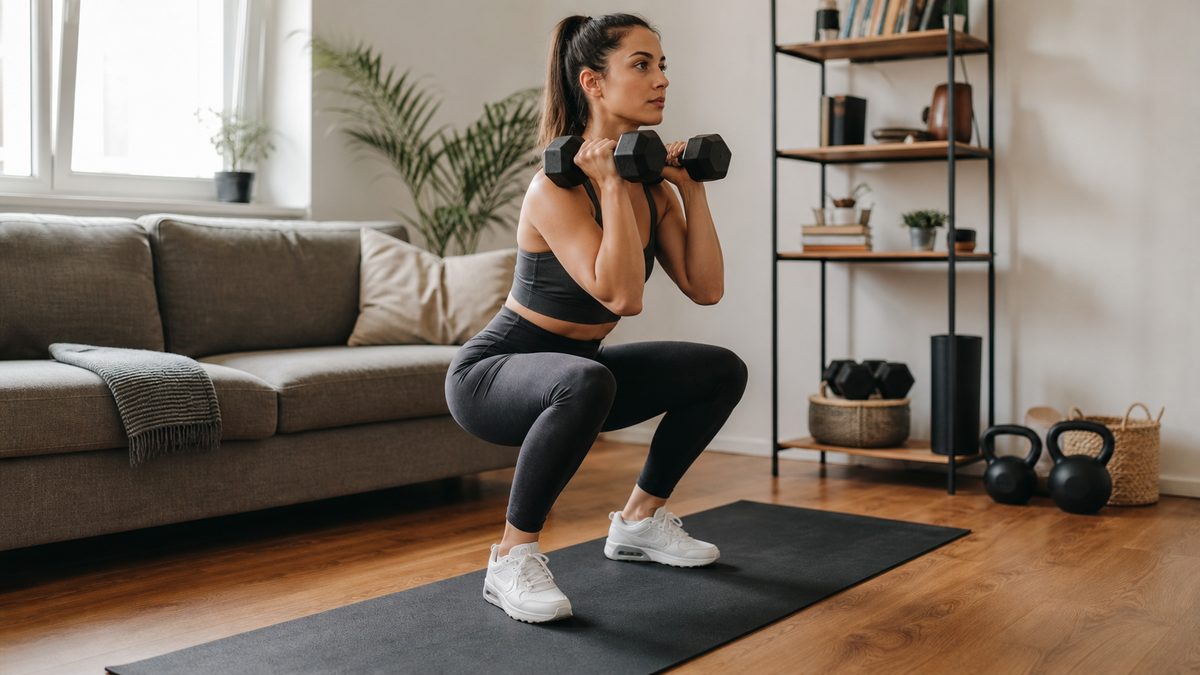
One dumbbell can supply adjustable resistance for a goblet squat, a supported or unsupported row, a floor press or a curl. You can train one side at a time when the exercise and setup suit that approach.
A two-kilogram dumbbell may be demanding for one exercise and too light for another. The label alone cannot tell you whether it is enough. The exercise version, repetition count, control and your present strength all affect the task.
Start with the exercises you can perform using your body weight. Then find the missing function. If you cannot set up a practical pulling movement, equipment that provides a pull has a clearer purpose than a random set of accessories.
How do you build a full-body workout without a long exercise list?
Give every exercise a job. A compact full-body routine needs movement roles rather than several exercises for each body part.
- Squat or lunge: Choose a bodyweight squat, goblet squat or reverse lunge that fits your floor area.
- Hip movement: Use a suitable hinge or bridge variation. A standing hinge needs room behind the hips. A bridge needs clear floor space.
- Push: Choose a wall push-up, raised push-up, floor push-up or suitable press.
- Pull: Use a dumbbell row or resistance-band row with an appropriate stance and setup.
- Trunk work: Select a controlled floor or standing movement, such as a bicycle crunch where floor space permits.
Different exercises can fill the same role. If a reverse lunge needs more room than you have, a squat may be the better choice. If floor work is unsuitable, choose a standing trunk exercise that you can control. The goal is to keep the movement job while changing the setup.
Exercise names can hide meaningful differences. “Row” does not tell you whether the movement uses a band, a dumbbell or a support. “Push-up” does not show whether your hands were on a wall, a bench or the floor. Name the version when you plan it.
Arrange the session around the room. Put the dumbbell where you can reach it without crossing an active band. Set up the mat once if several movements use it. Keep the walking path clear. This reduces needless room changes between exercises.
A long list can create the appearance of a complete workout while repeating the same job. Several squat variations still leave the routine without a pull. Checking movement roles makes gaps easier to see.
What can a repeatable home session look like?
Use one version from each movement role and keep the first session manageable. The sample below is a structure, not a fixed prescription. Choose versions that match your space, equipment and current control.
Prepare the room and movements
Clear the exercise area. Place any equipment where it will be used. Recheck raised supports and band positions. Then rehearse each planned movement without rushing. This lets you confirm that the real setup matches the written plan.
Use this compact session order
- Squat or lunge: Perform a suitable bodyweight or dumbbell version.
- Hip movement: Use a hinge or bridge that fits the available area.
- Push: Choose the wall, raised, floor or loaded version that suits you.
- Pull: Perform a band or dumbbell row with enough clearance.
- Trunk movement: Complete a controlled version and record repetitions or time.
Select a modest number of sets and a repetition range that lets you keep the planned version and controlled technique. Rest as needed before repeating an exercise. A rushed set that changes shape cannot be compared cleanly with the planned version.
You may add a carry or static hold when your equipment and room allow it. A carry needs a clear walking path. A hold needs a defined position and an explicit time unit in the log. Leave it out when the setup adds clutter or uncertainty.
Repeat the full-body template on non-consecutive days if that schedule lets you complete controlled sessions. The purpose of repetition is to make the workout easier to learn and compare. This guide does not set out a rigid ninety-day challenge or a detailed twelve-week plan. Seek professional guidance to refine your approach.
Modify or stop a movement when the support, space or execution is unsuitable. Replace it with an exercise that fills the same role under better conditions.
How can you make the workout harder with limited equipment?
Change one measurable part of the exercise while keeping the rest clear. Adding weight is one option, but it is not the only form of progression.
You can progress by:
- Completing more controlled repetitions with the same version.
- Adding another set while keeping the setup unchanged.
- Moving to a harder version of the exercise.
- Using a greater controlled range of motion.
- Slowing part of the movement and recording the tempo.
- Reducing assistance from a support.
- Adding external resistance when suitable equipment is available.
Do not change several variables and then treat the result as a clean comparison. If you switch from a raised push-up to a floor push-up while also changing the number of sets and repetitions, the log cannot show which change created the difference.
Keep the exact version stable long enough to compare sessions. Once the movement is suitable and repeatable, select one progression variable. Record what changed.
A bench-supported push-up and a floor push-up are separate versions. Ten repetitions of each do not describe the same task. The same rule applies when you change the height of the support, the range of a squat or the band used for a row.
A popular rule such as “3-3-3” cannot replace these decisions. A fixed pattern of exercises, sets or weekly sessions does not tell you whether the movements fit your room or match your current ability. Use the movement framework and a clear log instead of forcing your training into a catchy number.
Do not judge the routine by one workout or promise a set muscle gain from it. Results are affected by the program, how it is performed and the person doing it. Your immediate task is simpler: make the next session measurable.
What should you write in a home-training log?
Record the setup as well as the visible result. A log that lists kilograms alone hides bodyweight work. A log that leaves out supports can make an easier or harder exercise look unchanged.
Use these fields:
- Date: Identify the session.
- Exact exercise version: Include stance, support or range where needed.
- Sets and repetitions: Record what you completed.
- External weight: Add it only when an external load was used.
- Equipment or support: Name the dumbbell, band, wall or raised surface.
- Time: Write seconds or minutes for timed movements.
- Setup note: Record any detail needed to recreate the movement.
A bodyweight squat can be logged with its version, sets and repetitions. You do not need to assign a made-up kilogram value to your body. The record stays useful because the workload remains visible.
Here is a clear example:
- Bench-supported push-up: 2 sets of 8 repetitions, hands on stable raised support, body weight, no external load.
- Floor push-up: 2 sets of 8 repetitions, hands and feet on floor, body weight, no external load.
- Goblet squat: 2 sets of 10 repetitions, one dumbbell held at chest, external load recorded from the dumbbell label.
- Dumbbell row: 2 sets of 10 repetitions per side, one dumbbell, stance and support recorded.
- Static hold: 2 sets of 20 seconds, position and equipment recorded.
The two push-up entries have the same sets and repetitions, yet the log keeps them separate. That prevents a change in support from being mistaken for an identical workout. The timed hold includes seconds, so the entry remains clear when you review it later.
Before your next session, read the planned exercise version and confirm the required equipment, stable support and clear space. Then change one measurable variable and write down exactly what you did.